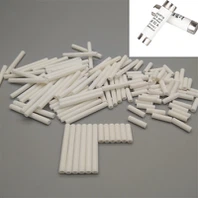
The small and medium-sized zirconia ceramic products that are simple in shape and suitable for dry pressing are often formed by dry pressing. A common problem that occurs during dry pressing of zirconia ceramics is product delamination. This is because the particles of zirconia ultrafine powder granules are very fine, so the particles are light and have poor fluidity, and delamination is prone to occur during dry pressing. From the production practice, it is known that the product layering is related to the finish and fit of the molding die, molding pressure, pressure method, pressure speed and holding time, demoulding method, and demolding speed. The following are the above aspects. The influence of factors on dry pressing is as follows:
1. The finish and cooperation of the forming mold
The dry pressing of zirconia ceramics requires high mold quality, first of all, mold hardness is required to meet certain requirements. Since the particles of the zirconia stabilizer are very fine and the fluidity is poor, the mold finish is required to be very high. If the finish is not up to the requirement, it will affect the flow of the material during dry pressing, resulting in the appearance of stratification. At the same time, if the mold fit is not good and the gap is large, the zirconia powder particles will flow out from the mold gap during pressing, resulting in less powder around the mold, so that the surrounding areas cannot be compacted during pressing. Delamination will occur due to inconsistent pressure transmission, so the matching requirements of the mold are higher.
2. Forming pressure
The forming pressure is critical in the dry pressing of zirconia. If the dry pressing pressure of zirconia ceramics is too small or too large, the ideal body cannot be pressed. If the pressure is too small, the density of the burned product will be low, the product will shrink, and the compaction of the green body will be prone to delamination. If the pressure is too high, the green body will also be prone to cracks, delamination and difficult demoulding. The appropriate molding pressure needs to be explored through production practice.
3. Pressurization method
Generally, there are two pressure methods for dry pressing of zirconia ceramics, one is single-sided pressure, and the other is double-sided pressure. When the pressure is applied on one side, the pressure at the side directly under pressure is higher, and an obvious pressure gradient appears. The worse the fluidity of the powder, the greater the pressure difference in the green body, and the more likely to be stratified. When double-sided pressing, the two ends of the blank are directly pressed, so the density at both ends is high, and the middle density is small. The effective transmission distance of the pressure gradient is half of that of single-sided pressing, so the density of the blank is higher than that of single-sided pressing. Much more uniform. Therefore, it is advisable to adopt double-sided pressure during dry pressing of zirconia ceramics.
4. Pressurization speed and pressure holding time
Poor control of the pressure speed and holding time for dry pressing of zirconia ceramics can also cause defects such as delamination in the zirconia body. The falling speed of the die should be slower. If the pressurization speed is too fast, the gas in the green body will not be easily discharged, which will cause the green body to be stratified, the surface is dense and the middle is loose, and there are phenomena such as bubbles. If the pressure holding time is too short, the external force will be removed when the pressure has not been transmitted to the desired depth, so that the gas in the body is not easy to discharge, and it is difficult to obtain a more ideal body, which will result in delamination and delamination of the body. There are phenomena such as bubbles. At the same time, the holding time should be uniform, otherwise it will cause uneven thickness of the product and result in waste.
5. Demoulding method and demoulding speed
When the zirconia ceramics are dry-pressed and molded, the green body is usually ejected from the mold cavity by a tool, and the demolding speed should be uniform and slow. If you are not careful, it will cause the green body to crack. Practice shows that the demolding tool should be flat when demolding, otherwise it will cause uneven force on the green body and cause cracking. In short, dry pressing is related to the above factors. To form an ideal body, the above aspects must be controlled.