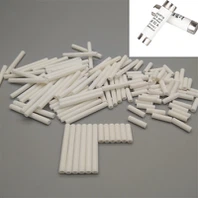
Compared with other ceramic processing methods, such as grouting, dry pressing and cold isostatic pressing, the "powder injection molding" technology is in four aspects: component size precision, mass production possibility, shape complexity and density uniformity. It is better than other processes. Currently, ceramic materials suitable for this process include alumina ceramic, zirconia ceramic and silicon nitride ceramic.
The ceramic injection molding process includes the following steps: mixing and granulating, injection, degreasing, and sintering. The first step is to combine polymer carrier plastic [such as polypropylene (PP) or polyethylene (Polyethylene, PE)] with ceramic powder is mixed and kneaded at a temperature above the melting point of the plastic. In order to improve the mixing effect and subsequent processing characteristics of the mixture, it is usually necessary to add an interfacial agent (Interfacial Agent) and a plasticizer (Plasticizer) to increase the yield of the injection product. Then the mixture is granulated and fed into the injection machine to control the injection pressure, the temperature of the injection material, and the injection holding pressure time and other parameters, and the ceramic/plastic green body can be injected into the mold. Its shape or The size is similar to the plastic products currently on the market, except that the green body contains more than 50 vol% of ceramic powder particles. Therefore, in terms of the characteristics of the injection rheology, the injection of ceramics is very different from the injection of plastics.
Before the ceramic green body is sintered at high temperature, the polymer plastic must be removed. The current removal methods include thermal debinding and solvent degreasing. In addition, the degreasing technology under development is the "vacuum degreasing method." And "supercritical liquid degreasing method." The heating rate used in thermal degreasing is usually 1-2°C/hour, so the required degreasing time is usually 40-120 hours, and the sample thickness must be less than five centimeters to avoid the defects of bubbles and cracks during the degreasing process. In order to improve the efficiency of degreasing and reduce the time of degreasing, the "solvent degreasing method" has only been developed in the past ten years. This method uses soluble polymer plastic solvents, such as acetone and alkanes, to immerse the green samples and remove most of them first. Low-molecular-weight plastics, and make appropriate fine pores in the sample, and then heat degreasing, the entire degreasing time can be shortened by more than 3/4. The technology of fast degreasing is the key technology currently under development.
In order to achieve uniform and fine pores in the degreased ceramic body, in the subsequent sintering process, to ensure that the physical properties of the sintered body are uniform, there are at least fourteen factors that need to be paid attention to before and after injection. In this way, a good injection molding process, coupled with a fast and complete debinding and sintering process, are the key steps to ensure the quality of ceramic products. Since the size control and reproducibility of the injection molded products are quite good (the industry can reach about six thousandths of the size reproducibility), the amount of mechanical grinding of the components after firing is very small, the processing cost can be reduced, and the product price Very competitive.