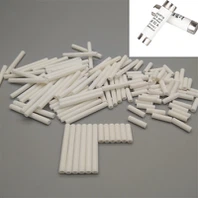
Ceramic dry pressing is one of the commonly used processes for forming technical ceramic embryos. The processing method is to mix the compound powder with an appropriate amount of binder for granulation, and then pour it into a steel mold and add force by a dry press. Under the action of external force strengthen the compactness of powder particles and colloidal molecules, and finally form a ceramic body with a certain strength; the ceramic dry pressing process can be processed with a height of 0.3~60mm and a processing diameter of 5~500mm. It is usually suitable for some simple shapes ceramic parts.
Characteristics of Ceramic Dry Pressing
1. Due to the low water content of the green body and the low drying shrinkage, the ceramic material waste rate is relatively low.
2. The cost of dry forming molds is high, and it's economical choice for only a large number of customized ceramic parts.
3. The dry forming blank has high density and strength and low shrinkage expansion coefficient, and the size control is also very accurate during the ceramic forming process.
4. In order to obtain high-quality compression performance, there are higher requirements for the powder particle composition and particle shape. Therefore, the compound powder needs to be finely processed before molding.
5. Dry molding has a high degree of mechanization and is usually produced by assembly lines. However, maintenance after mechanical failure is troublesome and must be completed in a short time, otherwise it will affect production.
However, dry pressing molds are difficult to produce large blank ceramic products; firstly, the mold wears a lot, the processing is complicated, and the processing cost is high; secondly, the pressing process only supports up and down pressing, and large ceramic products easily lead to uneven pressure distribution and uneven density. Uneven shrinkage will eventually lead to cracking and delamination of the ceramic. Therefore, if the dry pressing process is not suitable for ceramic products, UNIPRETEC can also provide different molding processes such as isostatic pressing, hot pressing and casting.