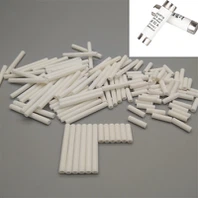
Alumina ceramic materials are super-hard materials, and general cutting tools are easy to damage the materials and also cause great damage to the processing equipment. With the development of science and technology, the electronic industry's microporous process requirements and precision requirements for ceramic substrates have undergone earth-shaking changes, especially for the micro-hole processing needs of alumina ceramic-based materials, micro-hole processing requires ultra-high processing accuracy At the same time, the processing efficiency must be ensured. As a special processing technology, laser processing has been widely used in the processing of alumina ceramic-based materials, especially the micro-hole processing technology of high-power fiber lasers. The application of this technology has greatly improved the scribing and scribing of ceramic-based materials. Punch demand.
In the QCW mode (pulse mode) and CW mode (continuous mode) of the fiber laser, the influence of the laser parameters on the 96 alumina ceramic substrate mainly has two aspects.
First, in the CW mode, it is necessary to apply the absorption solvent and with the assistance of nitrogen, it can solve the problem of scribing breakpoints and wire breakage. In the QCW mode, it can solve the problem of breakpoints and wire breakage without any pretreatment. The experiment can achieve a scribing speed of 200mm/s in CW mode, and a scribing speed of 150mm/s in QCW mode. In addition, when the average output power is constant, the scribing quality decreases as the duty cycle increases; the laser scribing depth is approximately proportional to the laser power.
Second, the laser drilling process experiment using the QCW mode of the quasi-continuous laser shows that the minimum taper of the micropore is 1.14° on the 0.6mm thick ceramic base material, the drilling parameters are: repetition frequency 200Hz, duty cycle is 20%, the defocus is 0, the air pressure is 0.3MP, the scanning speed is 240mm/min, and the power ratio is 15%; the degree of influence on the taper is in order of defocus, air pressure, repetition frequency, duty cycle, and laser power ratio , Scanning speed. The highest degree of influence is the defocus amount, and the lowest is the scanning speed.