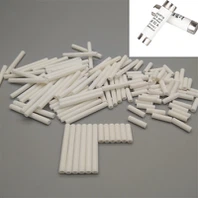
Technical Ceramics are widely used in various industries. Non-oxide ceramics occupies a relatively large proportion of technical ceramics. Non-oxide ceramics mainly refer to nitride ceramics, carbide ceramics, boride ceramics and silicide ceramics. They are generally bonded by strong covalent bonds, and non-oxide ceramic raw materials rarely exist in nature. It is necessary to artificially synthesize the raw materials, and then make ceramic products according to the ceramic process. This article will briefly introduce the following five common non-oxide ceramics.
▼ Silicon Nitride Ceramic
Silicon nitride (Si3N4) is a covalent bond compound, which has two crystal types, namely α-Si3N4 and β-Si3N4. α-Si3N4 is a granular crystal, β-Si3N4 is a needle crystal, both of which belong to the hexagonal crystal system. Due to the high temperature and wear resistance of Si3N4 ceramics, good thermal shock resistance, corrosion resistance, low friction coefficient and low thermal expansion coefficient, it has been widely used in many industrial fields.
▼ Boron Nitride Ceramic
The structure and some properties of boron nitride (BN) are similar to graphite, and it has two crystal types: hexagonal and cubic. Hexagonal can be converted into cubic BN at 1,300-1,800℃ and 6.5MPa, and its hardness is second only to diamond. The BN material with the hexagonal main crystalline phase has workability, white lubricity, and good thermal properties. It is an ideal electrical insulating and heat-dissipating material at high temperature environment and is also a outstanding metallurgical container material.
▼ Silicon Carbide Ceramic
Silicon carbide (SiC) ceramics have two crystal types, one is α-SiC, which belongs to the hexagonal crystal system. It is a high-temperature stable type; the other is β-SiC, which belongs to the cubic crystal system and is a low-temperature stable type. α-SiC can be transformed into β-SiC crystal form in the temperature range of 2,100-2,400℃. Silicon carbide ceramics have high high temperature strength, low high temperature creep, high hardness, wear resistance, corrosion resistance, oxidation resistance, high thermal conductivity, and good thermal stability, so it is a good high-temperature structural ceramic material above 1,400℃. At first it was mainly used as refractory materials and abrasives, such as steel-making nozzle bricks, furnace lining, kiln furniture, grinding wheels, etc., and then gradually used in some technical fields as high-temperature structural materials or heating elements, such as rocket exhaust nozzles, gas turbine blades, electrodes of magnetic fluid generators, electric furnace heating element, etc.
▼ Boron Carbide Ceramic
Boron carbide has the characteristics of low density, high strength, high temperature stability and good chemical stability. Also known as black diamond, it is an inorganic substance with a chemical formula of B₄C, usually gray-black. B₄C is one of the three hardest materials (second only to diamond and cubic boron nitride). Compared with diamond and cubic boron nitride, boron carbide is easy to manufacture and low in cost, so it is more widely used. It can replace expensive diamond in some places and is commonly used in grinding, drilling and other aspects. Boron carbide is typically used in tank armor, body shields, and many industrial applications. Boron carbide can absorb a large number of neutrons without forming any radioactive isotopes, so it is an ideal neutron absorber in nuclear power plants.