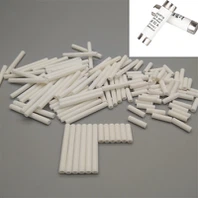
Alumina ceramics are classified into 99 alumina, 96 alumina, 95 alumina, 90 alumina, 85 alumina and other varieties according to the content of Al2O3. Sometimes those with Al2O3 content of 80% or 75% are also classified as ordinary alumina ceramic series. Among them, 99 alumina ceramic is used to make high-temperature crucibles, refractory furnace tubes and special wear-resistant materials, such as ceramic bearings, ceramic seals and water valve discs; 95 alumina ceramic is mainly used as corrosion-resistant and wear-resistant parts; as part of talc is often mixed, the electrical properties and mechanical strength of 85 alumina ceramic are improved, and it can be sealed with molybdenum, niobium, tantalum and other metals, and some are used as electric vacuum devices. How are alumina ceramic products made? It mainly includes the following four steps.
1. Powder Preparation
The alumina powder is prepared into powder materials according to different product requirements and different molding processes. The particle size of the powder is below 1ym. If high-purity alumina ceramic products are manufactured, in addition to the alumina purity of 99.99%, ultra-fine pulverization and uniform particle size distribution are required. When extrusion molding or injection molding is used, a binder and plasticizer should be introduced into the powder, generally a thermoplastic plastic or resin with a weight ratio of 10-30%. The organic binder should be at 150-200 °C with the alumina powder mixed uniformly in order to facilitate the molding operation. If semi-automatic or fully automatic dry pressing is used, there are special technological requirements for the powder, and the powder needs to be processed by spray granulation to make it spherical, so as to improve the fluidity of the powder and facilitate the automatic filling of the mold during the molding. In addition, in order to reduce the friction between the powder and the mold wall, it is necessary to add 1-2% lubricant (such as stearic acid) and binder PVA.
2. Molding and Pressing
The molding methods of alumina ceramic products include dry pressing, slip casting, extrusion, cold isostatic pressing, injection and other methods. Different product shapes, sizes, complex shapes and precision products require different molding methods. Following is the introduction of commonly used molding.
● Dry Pressing: The aluminum oxide ceramic dry pressing technology is limited to objects with simple shapes and inner wall thickness exceeding 1mm, and the ratio of length to diameter not greater than 4:1. The forming method is uniaxial or bidirectional. There are two types of presses: hydraulic and mechanical, and can be semi-automatic or fully automatic. The maximum pressure of the press is 200MPa. The output can reach 15-50 pieces per minute. Due to the uniform stroke pressure of the hydraulic press, the height of the pressed parts is different when the powder filling is different. However, the pressure applied by the mechanical press varies with the amount of powder filling, which easily leads to differences in size shrinkage after sintering, which affects product quality. Therefore, the uniform distribution of powder particles during dry pressing is very important for mold filling. Whether the filling amount is accurate or not has a great influence on the dimensional accuracy control of the manufactured alumina ceramic parts. Powder particles larger than 60 μm and between 60-200 mesh can obtain the maximum free flow effect and achieve the best pressure forming effect.
● Slip Casting: this way is the earliest molding method used for alumina ceramics. Due to the use of plaster molds, the cost is low and it is easy to form large-sized and complex-shaped parts. The key to slip casting is the preparation of alumina slurry. Usually water is used as the flux medium, and then the debonding agent and the binder are added, and the gas is exhausted after being fully ground, and then poured into the plaster mold. Due to the absorption of water by the capillary of the plaster mold, the slurry solidifies in the mold. When hollow slip cating, when the mold wall absorbs the slurry to the required thickness, the excess slurry needs to be poured out. In order to reduce the shrinkage of the green body, high-concentration slurry should be used as much as possible.
3. High temperature Sintering
The technical method of densifying the granular ceramic body and forming a solid material is called sintering. Sintering is a method of removing the voids between particles in the green body, removing a small amount of gas and impurity organic matter, so that the particles can grow and combine with each other to form a new substance. The heating device used for firing is the most widely used electric furnace. The sintering temperature varies according to the purity of alumina, and it is generally 1,000-1,800 degrees Celsius.
4. Grinding and Machining
Some alumina ceramic materials still need finishing after sintering. For example, products that can be used as artificial bones require a high surface finish, like a mirror surface, to increase lubricity. Due to the high hardness of alumina ceramic material, it is necessary to use harder grinding and polishing tile materials for finishing. Such as SiC, B4C or diamonds and so on. Usually use coarse to fine abrasives to grind step by step, and finally the surface is polished. Generally, Al2O3 micropowder or diamond paste of <1ym can be used for grinding and polishing. In addition, laser processing and ultrasonic processing, grinding and polishing methods can also be used.