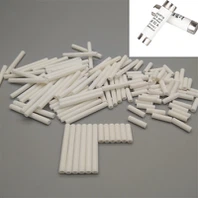
First identify the appearance of the "broken" beads. If the particles are more round and not sharp like broken glass, they are actually naturally worn beads. These beads may be ground into various shapes such as discs, ellipses, or smaller spherical shapes. This situation can be called abrasion, but the degree of abrasion is different.
From the point of view of force, when the dispersion disc transfers energy to the beads, if the viscosity of the liquid is very low, for example, when the sand mill is cleaned with solvent or water, the thrust of the material is not strong enough, and the beads may contact the dispersion disc. broken. This is an important reason why UNIPRETEC recommends shortening the cleaning time as much as possible. If the machine is cleaned with a low-viscosity liquid, the beads will also wear other beads or the contact parts of the sand mill. In order to obtain the longest service life of the grinding beads and sand mills, it is best to use resin for cleaning and maintain sufficient material viscosity during the production process.
Many people encounter broken beads after discarding old beads and loading new beads into a test run. The following analyzes this problem and discusses the solution.
1. The internal contact parts of the sand mill are not installed correctly: the dispersing disc is loose or the edge of the dispersing disc has sharp corners, there are foreign objects in the sand mill, the valve is loose, etc. These conditions may cause the grinding beads to break.
2. The contact parts of the sand mill are worn or incorrectly installed: the dynamic separator or the screen may be worn, the screen may be broken or installed upside down, if the grinding medium passes through the separator and enters the feeding pump, the pump is The beads are crushed before being blocked or shut down.
3. Back pressure: When the feeding pump is turned off, the residual pressure in the sand mill presses the beads into the pump, so that when the pump is started again, it will crush the beads. One-way valves are not necessarily reliable and sometimes allow beads to pass before the valve closes.
4. Backlog of grinding beads: If the grinding beads are accumulated at the bottom of the sand mill or the working pump is too fast, the grinding beads are concentrated at the outlet of the horizontal sand mill. The solution is to loosen the backlog of grinding beads in the on-off-on-off jog mode when starting the sand mill.
5. Scattering disc wear: This situation may be more difficult to determine. The edge of the worn dispersion disc is ground to be very uneven, and the edge of the dispersion disc is the place where the linear speed of the dispersion disc is the highest and may form a strong vortex. In addition, for vertical mills, the grinding beads are concentrated near the edge of the lower dispersion disc due to their own weight. The combination of all these factors may cause the grinding beads to break. The excessive wear of the dispersing disc is caused to a large extent by the slow speed of the feed pump and the excessive density of the grinding beads. This problem can be solved by replacing the worn-out parts and then loading the same batch of grinding beads.
6. Mix the grinding beads produced by different manufacturers. Different manufacturers' products may be different in terms of density. Doing so will increase the mutual wear between the beads. The solution is to never mix grinding beads from different manufacturers. If you suspect that there are mixed uses, you can only discard them all.
7. Because the used beads were accidentally added to the sand mill.
8. Rubbish or some small worn beads: There are often rubbish or some small worn beads attached to the screen, shaft, bracket, or other corners of the machine. When adding new grinding beads, these small things may loosen from the attachment position and mix into the newly added beads. This will cause the illusion that the new beads will be broken right away, but in fact you only see some of the natural worn-out beads. If the problem is not too big, these small things can be discharged naturally after a certain period of time. Otherwise, you must completely discard the old beads and replace them with new grinding beads.