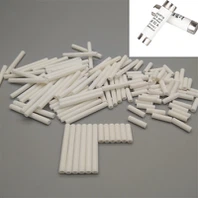
Ceramic powder, solvents, dispersants, binders, plasticizers, and, where required, defoamers and leveling agents are used in the production process of ceramic substrates.
● Ceramic Powder
Ceramic powder constitutes the majority of the casting slurry, and its characteristics have a direct effect on the end product's performance. Ceramic powder selection is based on the following principles: (1) Strictly limit the impurity content of ceramic powder. Because the chemical composition and properties of the ceramic powder will influence or even control the shrinkage and microstructure of the sintered material, the impurity content in the ceramic powder must be carefully controlled. (2) Strictly control the size and shape of ceramic powder particles. The particle size and shape of the ceramic powder have a significant effect on particle accumulation and the slurry's rheological characteristics. To compact the powder particles within the ceramic green body, the particle size must be as small as possible; however, the smaller the particle size, the larger the specific surface area, and the more organic additives required, which results in increased ceramic sintering shrinkage and decreased sintered body density. Generally, the optimal range of ceramic particle size is 1-4μm, the specific surface area is 2-5m2/g, and the particle shape is spherical.
● Solvent
The solvent's primary purpose is to dissolve binders, plasticizers, and other additives, scatter powder particles, and give the slurry with an appropriate viscosity. Prior to making a solvent selection, the following considerations must be considered: (1) It is capable of dispersing dispersant, binder, and plasticizer; (2) It is capable of dispersing ceramic powder; (3) It maintains chemical stability in the slurry, preventing chemical reactions with the powder; (4) It maintains the proper viscosity of the slurry; (5) It is capable of evaporating and burning out at the proper temperature; (6) It ensures that the blank solidifies without defects; (7) It is safe to use, e nvironmental pollution is minimal, and the cost is modest. Binary organic solvents, such as ethanol/methyl alcohol, ethanol/water, and ethanol/trichloroethylene, are often utilized.
● Dispersion Agent
The degree to which ceramic powder is dispersed in the solvent has a major effect on the green body's performance. Due to the tiny size and high surface energy of the powder particles employed in casting molding, the powder particles have a propensity to polymerize, making the slurry unstable. As a result, the casting slurry must include a specific dispersion that limits the degree of particle aggregation and the strength of the agglomerate. The dispersant's primary role is to moisten the surface of the ceramic powder, decrease the particles' surface potential energy, and raise the potential barrier between the particles, all of which contribute to the slurry's stabilization. Phosphate esters, ethoxylates, herring oil, polyacrylic acid, polymethacrylic acid, and ammonium salts are all frequently used dispersants.
● Plasticizers and Binders
The binder is used to join the ceramic particles and gives the green body its strength. It should be noted that the binder chosen must match the solvent in the following ways: it must be conducive to solvent volatilization and not generate bubbles; it must have a lower plastic transition temperature to ensure that no condensation occurs at room temperature; it must be capable of stabilizing the slurry and inhibiting particle formation. Settlement's function. The plasticizer is used to guarantee the blank film's flexibility, to decrease the binder's glass transition temperature, and to make the binder flow at a lower temperature. When exposed to external force, the chain molecules coil and stretch, increasing the degree of deformation. PVB/DBP and PVA/PEG are the most often used binder and plasticizer combinations, although two other plasticizer combinations are also utilized, such as PVB/DBP+DOP.