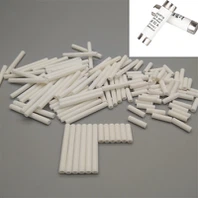
Typically, ceramic substrates are made of alumina powder and sintered at high temperatures to form sheet-shaped ceramic plates. It can be transformed into a ceramic circuit board for LEDs by printing a thick film circuit on a ceramic substrate. The high reflectivity ceramic substrate has a significantly higher reflectance than the standard alumina ceramic substrate, which can increase the LED light source's luminous efficiency. It can minimize the number of LED chips put on the substrate while maintaining the same light flux, hence lowering the cost of LED production.
Following COB (Chips on Board) packaging of ordinary ceramic substrates and mirror aluminum substrates, the light source packaged with mirror aluminum substrates has a higher luminous efficiency than the light source packaged with ordinary ceramic substrates. This is because the thermal conductivity and reflectivity of mirror aluminum substrates are greater than those of ordinary ceramic substrates. According to measurements, the typical ceramic substrate has a reflectance of approximately 92 percent and a bending strength of approximately 380Mpa, which is easily broken during assembly. The mirror aluminum substrate has a reflectivity of 98 percent; this type of metal substrate is strong and difficult to break during assembly, which results in increased assembly efficiency. However, in terms of electrical insulation performance, the alumina ceramic substrate has a breakdown voltage greater than 15KV/mm, whereas the mirror aluminum substrate has a breakdown voltage of approximately 2.5KV. It is critical to guarantee that the ceramic substrate has a strong electrical insulating strength and to optimize its reflectivity.
Associated investigations demonstrate that the ceramic substrate formed by adding SnO2 to Al2O3 has a reflectivity of up to 99.6% and a bending strength of 385Mpa. Although the ceramic substrate created by adding ZnO2 to Al2O3 has a poor flexural strength, it has a reflectivity of 98.4 percent, which is higher than the 92 percent reflectivity of typical ceramic substrates. The ceramic substrate formed by the addition of ZrO2 to Al2O3 has a bending strength of 787Mpa and a reflectivity of 98.6 percent. The COB with a 99 percent high reflectivity ceramic substrate is 6% – 7% more higher than the COB with a 92 percent high reflectivity ceramic substrate. COBs built of 99 percent high reflectivity ceramic substrates have a light efficiency advantage of 1% to 2% over COBs composed of 98 percent mirror aluminum substrates. Experiments have demonstrated that when the reflectivity of the ceramic substrate is identical to that of the mirror aluminum substrate, the light effect produced by the COB light source packaged with the high reflectivity ceramic substrate can be as good as that produced by the COB light source packaged with the mirror aluminum substrate.