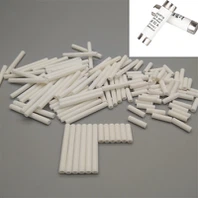
Hexagonal boron nitride (h-BN) is a fascinating compound that possesses unique electronic properties. Composed of boron and nitrogen atoms arranged in a hexagonal lattice structure, h-BN shares similarities with graphene, earning it the nickname "white graphene." Let's delve into its electronic characteristics in detail.
Insulating Property
First and foremost, hexagonal boron nitride is an insulator, meaning it has a wide energy bandgap that restricts the flow of electric current. With a typical bandgap ranging from 5.5 to 6.0 electron volts (eV), h-BN exhibits a higher bandgap compared to graphene. This property renders h-BN suitable for electronic applications requiring electrical insulation.
High Thermal Conductivity
Another remarkable aspect of hexagonal boron nitride is its exceptional thermal conductivity, making it an outstanding heat conductor. Among known insulators, h-BN boasts one of the highest thermal conductivities. This makes it highly desirable for applications involving heat management and thermal interface materials in electronic devices.
High Dielectric Constant
Additionally, hexagonal boron nitride demonstrates a high dielectric constant, also known as relative permittivity. The dielectric constant measures a material's ability to store electrical energy in an electric field. Typically ranging from 4 to 7, h-BN's relatively high dielectric constant makes it valuable for capacitors and other electronic components reliant on storing electrical charge.
Smooth Surface
Moreover, h-BN possesses an atomically smooth and flat surface, contributing to its low surface roughness. This characteristic is particularly advantageous in nanoelectronics and thin-film devices, as the smooth surface minimizes scattering and enhances the mobility of charge carriers within electronic devices.
Chemical Stability
Chemical stability is another noteworthy feature of hexagonal boron nitride. It exhibits resistance to chemical reactions and degradation under normal operating conditions. This stability ensures the long-term reliability of electronic devices employing h-BN.
Some Applications of h-BN
The unique combination of h-BN's properties finds application across a wide range of fields, including electronics, optoelectronics, photonics, and thermal management. In electronics, h-BN serves as a dielectric material in transistors and insulating layers within electronic devices. It is also utilized as a protective coating and a substrate for graphene-based devices.
In a nutshell, the characteristics of hexagonal boron nitride enable its use in various electronic applications, contributing to advancements in technology and innovation.