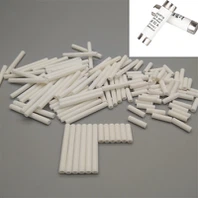
Aluminum nitride ceramic has the advantages of high thermal conductivity, good electrical insulation and dielectric properties under high temperature environment, high material strength at high temperatures, low thermal expansion coefficient matching with semiconductor silicon materials, non-toxic, etc., AlN Aluminum Nitride is an ideal heat dissipation material for ceramic substrates and electronic packaging. The core and key performance index of aluminum nitride ceramic is high thermal conductivity. Although the thermal conductivity of aluminum nitride can reach 320W/(m·K) in theory, the thermal conductivity of actual products is caused by impurities and defects in aluminum nitride. The rate is less than 200W/(m·K). The main factors affecting the thermal conductivity of aluminum nitride ceramics are the oxygen content of the crystal lattice, density, microstructure, and powder purity. The following is an introduction to several major factors.
1. Oxygen content and impurities
For aluminum nitride ceramics, due to its strong affinity for oxygen, oxygen impurities are easy to diffuse into the AlN lattice during the sintering process, which is directly related to a variety of defects and is the main source of affecting the thermal conductivity of aluminum nitride. In the phonon-defect scattering, the main role is the presence of impurity oxygen and alumina. Because aluminum nitride is easily hydrolyzed and oxidized, an aluminum oxide film is formed on the surface, and the aluminum oxide is dissolved into the aluminum nitride crystal lattice. Make the aluminum nitride crystal lattice appear anharmonic, affect the phonon scattering, so that the thermal conductivity of aluminum nitride ceramics is sharply reduced.
2. Density
According to the thermal conductivity of aluminum nitride, a large number of pores in low-density samples will affect the scattering of phonons, reduce their mean free path, and thereby reduce the thermal conductivity of aluminum nitride ceramics. At the same time, the mechanical properties of low-density samples may not meet the requirements of related applications. Therefore, high density is a prerequisite for aluminum nitride ceramics to have high thermal conductivity.
3. Microstructure
The microstructure of aluminum nitride ceramics has a one-to-one correspondence with its thermodynamic properties. The microstructure includes grain size, morphology, and the content and distribution of the second phase of the grain boundary. The actual aluminum nitride ceramic is a multi-phase polycrystalline, which is mainly composed of aluminum nitride crystal phase, aluminate second phase (grain boundary phase) and pores and other defects. In addition to studying the lattice defects of aluminum nitride, many people have also studied the crystal grains, grain boundary morphology, composition, nature, content, and distribution of the grain boundary phase of aluminum nitride, and their relationship with thermal conductivity. After extensive research, it is generally believed that the distribution of the aluminate second phase has the most important influence on the thermal conductivity.